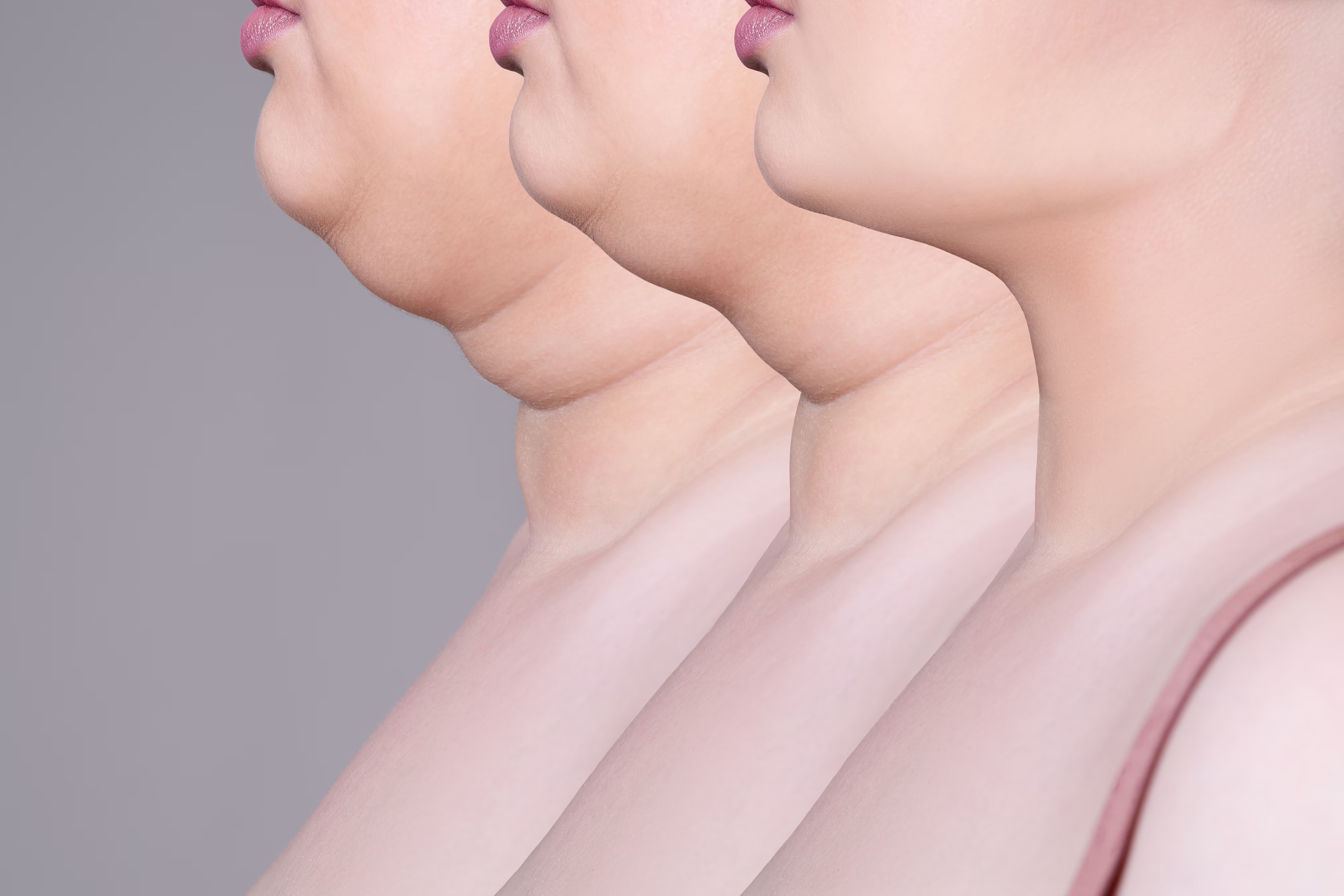
Submental fullness that persists despite treatment is rarely a coincidence. It is usually a sign that the underlying cause has not been fully addressed.
Many patients begin with non-surgical approaches—fat-dissolving injections, skin tightening, or repeated combination treatments—expecting gradual improvement. In some cases, this works. In many, it does not.
When fullness remains unchanged or only partially improved, the issue is not effort. It is misalignment between treatment and anatomy.
Why Some Double Chins Do Not Respond
The assumption that submental fullness is simply excess fat is one of the most common oversimplifications in aesthetic treatment.
In reality, the area is influenced by:
- Fat distribution
- Skin elasticity
- Muscle structure
- Skeletal projection
When one or more of these factors are overlooked, treatment tends to fall short.
The Limits of Fat Reduction Alone
Non-surgical treatments often focus on fat reduction.
Options such as Kybella are designed to gradually break down fat cells. When the issue is small, well-localised fat deposits, this can be effective.
However, persistent fullness is rarely that simple.
Reducing fat alone does not address:
- Loose or descending skin
- Muscle banding
- Structural imbalance
In some cases, removing fat can even accentuate these underlying issues, making the area appear less refined rather than more.
Skin Laxity: The Hidden Factor
Skin quality plays a defining role in how the submental area responds to treatment.
When elasticity is strong:
- Skin contracts naturally after fat reduction
- Contour improves in a predictable way
When elasticity is reduced:
- Skin may not retract
- Fullness can appear unchanged, even after volume is reduced
This is often misinterpreted as treatment failure, when in reality it is a limitation of the method used.
Structural Anatomy: The Overlooked Cause
In some patients, persistent fullness is not caused by excess tissue—but by insufficient support.
A recessed chin or weaker mandibular structure can:
- Blur the jawline
- Create the appearance of fullness beneath the chin
In these cases, repeated fat reduction treatments will not resolve the issue. The contour remains soft because the underlying framework has not changed.
The Role of Muscle (Platysma)
The platysma muscle contributes to the definition of the neck and jawline.
With age, it can:
- Separate
- Form visible bands
- Alter the contour of the lower face
This creates a form of fullness that is not responsive to:
- Fat reduction
- Skin tightening alone
Without addressing the muscle layer, improvement remains incomplete.
When Treatments Plateau
A common pattern emerges in persistent cases:
- Initial treatment produces mild improvement
- Additional sessions deliver diminishing returns
- The overall contour remains soft
At this stage, the limitation is not the number of treatments—it is the ceiling of what non-surgical methods can achieve.
Continuing beyond this point often leads to:
- Accumulated cost
- Extended timelines
- Ongoing dissatisfaction
Why Incremental Change Is Sometimes Not Enough
Non-surgical treatments are designed to create gradual improvement.
For some patients, this is appropriate.
For others—particularly those seeking:
- Clear jawline definition
- Noticeable structural refinement
incremental change does not align with the desired outcome.
The result is a mismatch between:
Expectation and capability
When a Different Approach Becomes Necessary
Persistent submental fullness is often an indication that a more comprehensive approach is required.
This may involve:
- Surgical fat removal for greater precision
- Skin excision and tightening
- Muscle repositioning
- Structural enhancement
These approaches do not work around the problem—they resolve it at its source.
Recognising the Transition Point
Knowing when to move beyond non-surgical treatment is critical.
Key indicators include:
- Multiple treatments with limited overall change
- Continued softness of the jawline
- Visible skin laxity
- Lack of improvement in profile
At this stage, continuing the same approach rarely produces a different outcome.
A More Accurate Way to Think About Treatment
Rather than viewing non-surgical treatments as a first step that can always be extended, it is more accurate to see them as a specific solution for a specific problem.
When the problem changes—or is more complex than initially assumed—the solution must change as well.
What Defines an Effective Outcome
An effective result is not simply a reduction in fullness. It is:
- A clear, natural contour
- A defined transition between face and neck
- Balance with the rest of the facial structure
Achieving this requires alignment between:
- Diagnosis
- Method
- Execution
Without that alignment, even repeated treatment will not produce the desired refinement.
Final Perspective
Persistent submental fullness is not uncommon—but it is rarely without explanation.
When non-surgical treatments fail to deliver meaningful change, the reason is usually clear:
The treatment is not addressing the primary cause.
Recognising this early allows for a more considered approach—one that moves beyond incremental improvement toward structural correction and lasting definition.
That shift is often what separates temporary change from a result that holds.