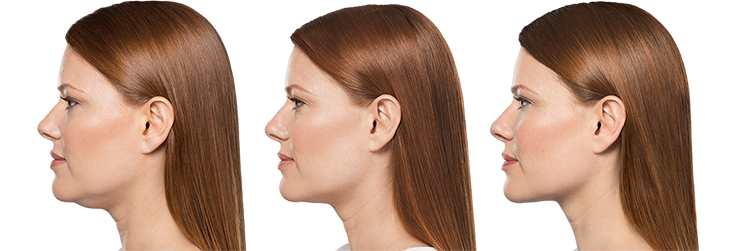
Non-surgical treatments for submental fullness are often positioned as accessible, low-commitment solutions. They appeal to patients seeking improvement without surgery, downtime, or visible intervention.
In carefully selected cases, they can offer subtle refinement.
But the key word is subtle.
Understanding where these treatments succeed—and where they fall short—is essential. Without that clarity, patients are often led into prolonged treatment cycles with incremental results that never fully resolve the concern.
What Non-Surgical Treatments Are Designed to Do
Non-surgical approaches typically aim to:
- Reduce small pockets of fat
- Improve mild skin laxity
- Enhance overall skin quality
They do not:
- Reposition underlying structures
- Address significant tissue descent
- Create sharp, lasting contour
This distinction defines their role.
The Primary Non-Surgical Options
Fat-Dissolving Injections
Kybella is the most widely used injectable for submental fat reduction.
It works by:
- Breaking down fat cells over time
- Allowing the body to gradually clear them
Best suited for:
- Mild, localised fat deposits
- Patients with good skin elasticity
Limitations:
- Requires multiple sessions
- Swelling can be significant and prolonged
- Results develop gradually—and may plateau
It is not designed for structural contouring or more advanced cases.
Energy-Based Skin Tightening
Technologies using radiofrequency or ultrasound aim to stimulate collagen and improve skin firmness.
They may:
- Provide modest tightening
- Improve skin texture slightly
They do not:
- Remove meaningful fat
- Redefine the jawline in a structural way
Their role is supportive rather than transformative.
The Core Limitation: Lack of Structural Change
The defining limitation of non-surgical treatment is simple:
It cannot reposition tissue.
Submental fullness is rarely caused by fat alone. It often involves:
- Skin laxity
- Muscle changes
- Structural imbalance
Without addressing these elements, improvement remains partial.
This is why results from non-surgical treatments often:
- Appear modest
- Require ongoing maintenance
- Fall short of initial expectations
When Non-Surgical Treatment Works
There is a clear, appropriate use case.
Non-surgical treatments can be effective when:
- Submental fullness is mild
- Skin retains strong elasticity
- The patient prefers gradual change
In these cases, they can:
- Soften early fullness
- Provide subtle contour improvement
- Delay the need for more definitive intervention
The outcome is not dramatic—but it can be proportionate.
When Limitations Become Apparent
Limitations tend to emerge in predictable scenarios.
Moderate to Significant Fat
Fat-dissolving treatments become inefficient as volume increases. Multiple sessions may produce only incremental change.
Skin Laxity
Reducing fat without tightening skin can:
- Reveal looseness
- Create a less defined contour
Age-Related Changes
As tissue descends and structure shifts, non-surgical treatments cannot restore position.
Desire for Definition
Patients seeking a clearly defined jawline often find:
Non-surgical methods do not deliver the level of precision required.
The Risk of Over-Treatment
One of the more common patterns is repeated non-surgical treatment in an attempt to push beyond its limits.
This can lead to:
- Accumulated cost
- Extended downtime across multiple sessions
- Diminishing returns
The issue is not the treatment itself—it is continuing past the point where it remains effective.
Recognising that threshold is critical.
Non-Surgical vs Surgical: A Matter of Capability
The distinction between non-surgical and surgical approaches is not about preference. It is about capability.
Non-surgical treatments:
- Gradual
- Limited in scope
- Best for early or mild concerns
Surgical approaches:
- Structural
- Precise
- Capable of comprehensive correction
Neither is inherently superior—but each has a defined role.
A More Considered Approach
An effective treatment plan does not default to the least invasive option. It aligns the intervention with the anatomy.
In practical terms:
- Mild fullness, strong skin → non-surgical may be appropriate
- Moderate fullness → surgical fat removal often more efficient
- Laxity or structural change → lifting or repositioning required
This approach avoids:
- Under-treatment
- Over-treatment
- Misaligned expectations
What Patients Often Overlook
The appeal of non-surgical treatment is understandable—but it can obscure a more important question:
Will this approach deliver the level of change I am actually looking for?
If the answer is no, the more conservative option becomes less efficient—not more.
Final Perspective
Non-surgical submental treatments have a clear place in aesthetic care. When used within their limits, they can provide subtle, worthwhile improvement.
But they are not a replacement for structural intervention.
Understanding their limitations is not about discouraging their use—it is about ensuring they are used appropriately, and with realistic expectations.
When that clarity is present, outcomes tend to align more closely with intent.
And that is what defines a considered approach.